
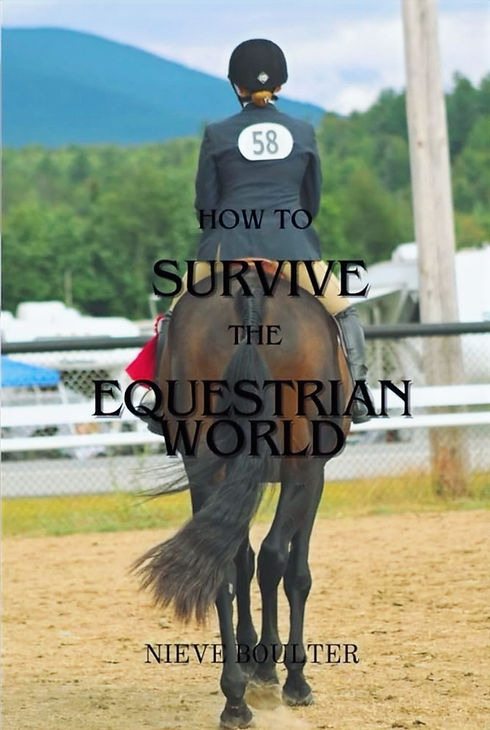
HOW TO SURVIVE
THE
EQUESTRIAN WORLD
Nieve Boulter

The Main Concern
The horse industry is notorious for exploiting beginner riders, scamming horse buyers, mistreating horses, and creating toxic environments for boarders, students, and leasers. From using young lesson kids for free farm labor, to the overuse of the old school horses in need of retirement, to the unethical methods of equestrian training, the issues in the horse business are endless.
Issues this book addresses
Each chapter begins with a specific issue drawing from personal experience in the horse world, providing a solution to each problem. You will learn the truth behind the corruption in this industry, and you will learn how to navigate the difficulty within this sport. This book teaches how to deal with problematic horses, unethical trainers, poorly run barns, and the overall corruption that exists in this business and lifestyle. Learn how to avoid scams when purchasing horses, how to manage trainers who exploit their students for free labor, and how to avoid trainers who utilize abusive training methods while coping with the cutthroat atmosphere of competition.

Are you...
A life-long equestrian?
an Equestrian student?
a Trainer?
A Horse buyer/seller?
A Horse business owner?
An Equestrian newcomer?
This book is a must read.
Highlights in
How to Survive the Equestrian World
"The troubled horse is not a bad horse, it just has bad training. That is worth remembering. If you can recite this in your head, or even out loud, while in the midst of a frustrating training session with a problematic horse, it may just relieve resentment and blame you are subconsciously placing on the horse. It is easy to blame the horse for hating his ears being touched, but have you considered his previous owner who improperly used a twitch? It is easy to blame the horse for ignoring rein contact, but have you considered the previous rider who had a harsh hand?" - 262, The Troubled Horse
"Be grateful that you were the rider at the barn who had to work extra shifts to be able to get one more lesson a week; it will make you appreciate hard work. Be grateful that you had to deal with the stubborn green horses because you could not afford the fancy ones; it will make you a better rider. Be grateful that you weren’t able to own your own horse as a kid; it will make owning one later in life more rewarding. Adversity is what gives things meaning." - 325, The Money Hindrance
"Those who think they are perfect will end up worse in the end. Even the top level riders take lessons regularly, and many of these highly competitive riders will only ride in the presence of a teammate or colleague in order to be held accountable, and to prevent bad habits from forming. Being honest in your self assessment can only benefit you— contrarily, lying to yourself is only protecting your fragility" - 330, Gift of Knowledge
"... do not sacrifice your morals or beliefs to be respected by your trainer. If you feel you need to conceal a piece of yourself in order to conform to a trainer’s, barn owner’s, or anyone’s morals, then that is probably not a healthy person to keep in your circle. It’s okay to want to be liked, it's not okay to pretend to be someone else in order to be liked. Make a good relationship with your trainer, but do not burden yourself trying to be their favorite. You’re at the barn to learn how to ride and become a better horseman, not to be liked by everyone." - 342, Favoritism
"If you find yourself having to lie in a sale advertisement, that is a reflection of your lack of training and care for the horse. Horses will only act out over two things: a lack of training, and physical or mental discomfort. If a horse is taken care of properly, and at the minimum, taught basic ground and under saddle manners, lying on a sale advertisement or drugging up a horse for a client would be unnecessary. More importantly, if you were an ethical horseman, those options would be out of the question." - 354, Truth Behind Sale Ads
"... but times may come where being an equestrian gives you some of the worst days of your life. There is beauty in this, because if there were no sacrifices in this sport and lifestyle, it would never be this rewarding nor meaningful.
Do not allow your bad experiences to tarnish your overall outlook on being an equestrian. Doing a sport that involves not only another living being, but a magnificent one, makes the potential for suffering so much greater. The greater the potential for reward, the greater the risk for suffering. But that is the beauty in it." - 360, Dark Days



About the Author
I grew up riding horses from family's farms in Ireland, and since then my love for the sport never ceased. I started taking lessons at a young age, bouncing around from various disciplines beginning with dressage, then hunters, then jumpers, and am currently training in eventing. Throughout these years, I have trained a Mustang from the wild, several OTTBs, and I recently bought my first horse, an OTTB project horse with 22 starts and 6 wins.
Other books by this author:
"You are not fat because of what you eat, you are fat because of what you think." The Fitness Psychology Cookbook focuses on the emotional, psychological, and cognitive ways that impact your fat loss or strength goals. Each chapter ends with a delicious recipe that actually tastes good and will simultaneously fit into your dietary goals.
The basis of your journey will resolve around finding your true self respect, which will give you a motive to improve, and the tools to become a stronger person. This book contains formulated measures that can be taken to overcome the mental obstacles that impede on losing fat or achieving goals in the area of fitness, from someone who grew up fat and was finally able to break the habits that were keeping me fat.
Although this is a book about weight loss, the means of getting fit have more to do with life in general. Fixing your body starts with fixing your mind and environment first. The Fitness Psychology Cookbook takes all the components that control your mindset, and explains how to alter them to create a life that is set up for a successful fitness journey.
Available on Amazon

